
Years of low contributions in a city struggling with budget pressures have led to billions of dollars in unfunded liabilities
— Financial Times | Yu Sun —
Chicago’s underfunded pension system is in dire condition, with some funds at risk of becoming “completely insolvent” in a market correction, Chicago mayoral candidate Susana Mendoza warned.
“If the market gets a cold,” Mendoza said in an interview with the FT, “I don’t even know that we’ll survive with pneumonia.”
The remarks by Mendoza, currently Illinois’ top finance official, came as Chicago’s four city employee pension funds reported an aggregate funded ratio of 28.1 per cent last year, compared with a national average of 82.5 per cent, leaving the city’s retirement system among the worst funded in the US.
The warning highlights the financial pressures facing US public pension systems, many of which remain burdened by large unfunded liabilities despite several years of strong stock market gains. Chicago has also become a test case for how state and local governments may cope as cash-strapped public pension plans edge towards insolvency.
“Chicago’s pension crisis is extremely important to the rest of the country because everyone is kind of wondering what happens when the pension system is completely in a free fall,” said Zachary Christensen, managing director at the Reason Foundation.
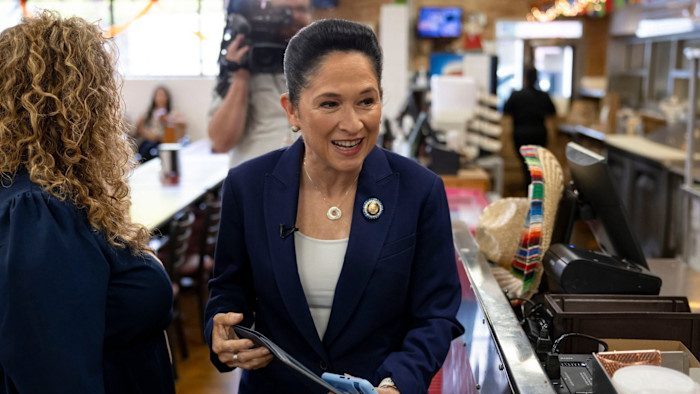
‘If the market gets a cold,’ Chicago mayoral candidate Susana Mendoza said, ‘I don’t even know that we’ll survive with pneumonia’
Many US public pension plans have struggled with financing gaps, with 76 state and local retirement systems less than 75 per cent funded last year, according to the Equable Institute, a think-tank.
“The costs of pension debt paralysis continue to grow while the fragile system remains vulnerable to market downturns and unpredictable political policy,” Equable said in a report this year.
Few US cities better exemplify the country’s public pension crisis than Chicago, whose retirement plans’ aggregate funded ratio has fallen by more than two-thirds since 2000.
For decades, successive city administrations cut contributions to Chicago’s public retirement system to ease short-term budget pressures, contributing to tens of billions of dollars in unfunded pension liabilities.
The recent US stock boom has done little to change the broader picture as the rally has failed to help the funds balance their books and they remain vulnerable to a downturn, according to Mendoza.
“We have missed quite a significant wave of excellent returns and we can’t get that back,” she said, adding that the funds would be “toast” if the market turned lower.
Further pressure may come from an Illinois law enacted last year that boosted pension benefits for Chicago police officers and firefighters hired since 2011, which would reduce the funded ratios of their pension funds to 18 per cent from roughly 25 per cent, according to city estimates.
“You are in the area of near-insolvency at this funded level,” said Mendoza. City employees say they should not bear the cost of decades of underfunding by the government.
Chicago’s pension crisis is emerging as a key issue in the city’s 2027 mayoral race, with candidates including US congressman Mike Quigley. While most of them have made the city’s fiscal challenge a central campaign issue, Mendoza has taken one of the strongest positions on pensions, arguing Chicago cannot afford further benefit enhancements that would pressure an already stretched system.
“Having something is certainly better than having 100 per cent of nothing,” she said. Mendoza acknowledged any overhaul of Chicago’s pension system would require difficult compromises.
“Realistically, how do we get these pension funds stabilised?” she said. “Everyone is going to potentially have to talk about sacrifice.”
Many of Chicago’s public workers reject that argument, saying they should not bear the cost of decades of pension underfunding by the government.
“The pension debt is caused by the failure of the city to pay what it owed in the past,” said Anders Lindall, a spokesperson for AFSCME Council 31, Illinois’ largest public employees’ union, “saying that you won’t talk about future benefits is actually not addressing the problem. That’s kind of a misdirection play”.
Mendoza also proposed expanding voluntary pension buyouts, allowing eligible workers to take lump-sum payments in exchange for giving up certain future benefits, while directing any surplus city revenues towards pension stabilisation and the city’s rainy-day fund.
“Anything and everything is on the table because we do have to stabilise the city’s finances,” she said.


